- New arrival
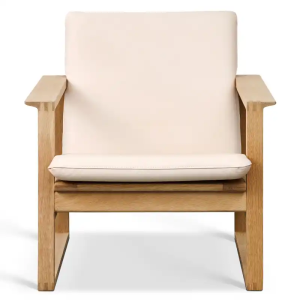
- New arrival
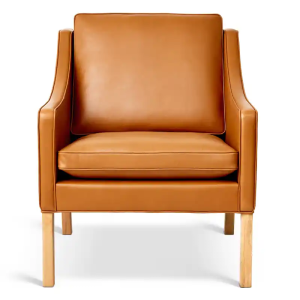
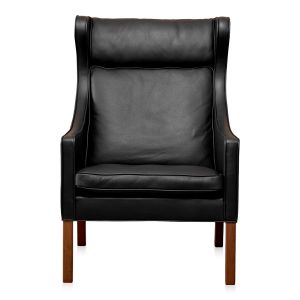
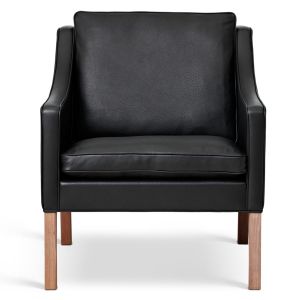
Danish furniture designer Børge Mogensen
Internationally, Børge Mogensen (1914-1972) may be somewhat overlooked, but in Denmark his furniture remains beloved and highly sought after. Of the great Danish furniture designers of his generation, Børge Mogensen was perhaps the most widely cherished – and, in his own way, the greatest. His work appealed broadly both then and now, while his uncompromising approach to function, design and materials brought him into Danish homes – and sometimes into conflict with his colleagues.
Børge Mogensen qualified as a cabinetmaker in 1934 before studying furniture design at both the School of Arts and Crafts and the Royal Danish Academy. At the Academy, Børge Mogensen was taught by Kaare Klint, one of Danish modernism’s foremost advocates. Klint’s insistence on function and human needs resonated deeply with the young Mogensen, and together they helped define the golden age of Danish furniture. At the Academy, Mogensen also found a lifelong friend in his fellow student Hans J. Wegner.
With Børge Mogensen, it makes little sense to distinguish between ’mind’ and hand, for he embodied both. His background as a craftsman was arguably the driving force of his career. Børge Mogensen described himself as a furniture maker – not a designer.
Although he called himself a furniture maker, Mogensen was driven by an ideological, almost fanatical commitment to function, and strongly criticised colleagues who departed from functionalist principles. He was equally uncompromising about materials, favouring natural materials, perhaps a little metal, and Danish timbers. Ironically – given his cabinetmaking background – he was more flexible about production methods and understood the importance of keeping prices within reach.
He was exceptionally productive throughout his career, leaving an extraordinary number of masterpieces. His talent and genius came at a cost: a hard-lived life marked by perfectionist self-discipline and excess may have contributed to his early death. He was 58 years old.

Børge Mogensen’s greatest works
From 1942 to 1950, Mogensen led FDB’s furniture design studio, creating several of the most important designs of both his career and the wider Danish furniture tradition. His years at FDB produced the iconic Windsor chairs, still made and sold in great numbers today, as well as the People’s Chair and the Shaker furniture.
The People’s Chair with its woven seat dates from 1947, as does his Shaker table. Inspired by the Shaker movement, the furniture was designed for practical use and easy cleaning in everyday life. Few masterpieces in the Danish furniture tradition are more understated than Mogensen’s Shaker designs.
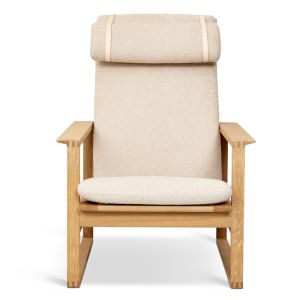
The Spoke-Back Sofa may be the exception. Conceived in 1945, it took another 20 years before Denmark was ready for Mogensen’s hybrid of a Danish sofa, French chaise longue and British daybed. The distinctive checks of its wool upholstery became almost a badge of the intellectual set, and it is now a Danish style icon. Ironically, a design conceived as democratic and functional has become a symbol of understated luxury.
Børge Mogensen also created lounge chairswith a more assertive design character. Although almost any Mogensen piece can sit comfortably in almost any interior, the Hunting Chair from 1950 has an unmistakably sharper edge. Its form, seat height and construction verge on decadence, while the materials, exposed joints and buckles keep it grounded and distinctly Børge Mogensen’s.
In 1958, he created the equally iconic Spanish Chair. Mogensen often reimagined historic furniture for modern, practical and functionalist life, and on a journey through Spain he encountered a traditional chair of Moorish origin. It inspired the Spanish Chair in saddle leather and Danish timber, with armrests broad enough to dispense with a coffee table.
In 1952, between the two lounge-chair designs, he created the Søborg chairs and matching table. Their light, curved expression distinguishes them from much of his other furniture – aligning them more closely with the period’s bent-veneer movement.
In 1958, he also created the Library Table with folding leaves, which remains highly sought after today.
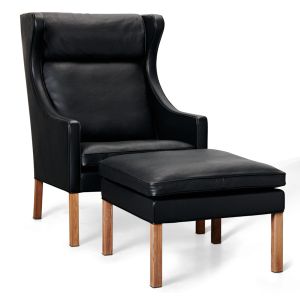
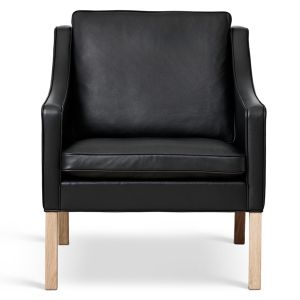
In 1963, he created the elegant and beloved 2200 series, including the Wing Chair. The austere expression of the Shaker furniture and People’s Chair gives way here to pieces that are comfortable as well as minimalist. They are unmistakably by Mogensen, yet their pronounced focus on comfort sets them apart from much of his wider catalogue.
Although Børge Mogensen never achieved the same worldwide recognition as some leading figures of his generation, he may have accomplished the most. He made functionalist furniture part of everyday life and created pieces around which a nation could gather. Factory workers and industrialists alike embraced his furniture, and later generations continue to do so.