- SaleNew arrival
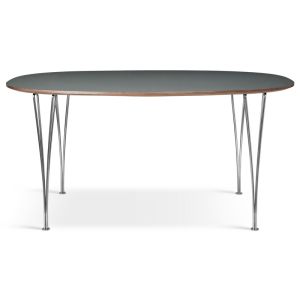
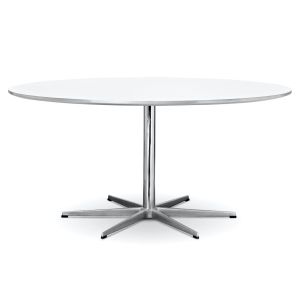
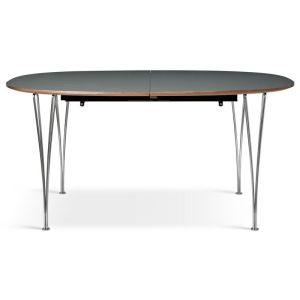
Piet Hein
Piet Hein (1905-1996) defies easy classification: the beloved poet was both a writer and a scientist to his core. This was most evident in the objects he designed. His mathematical formula for the celebrated superellipse gave rise to one of the most recognisable tables in Danish furniture history: the Ellipse table. This elegant compromise between a circle and a square has been applied to everything from urban planning and diplomacy to space travel. Yet it is Fritz Hansen’s tables, made to uncompromising standards, that secured the lasting reputation of Piet Hein’s famous Ellipse table.
What is Piet Hein known for?
Among a generation of eccentric talents, Piet Hein (1905-1996) may have been the most brilliant – and the most eccentric – of Denmark’s golden age of furniture. Unlike many of his celebrated contemporaries, he was neither an architect, cabinetmaker nor conventional designer. He was a scientist and a poet; a philosopher, inventor, author, globalist and mathematician. He was also the mind behind perhaps the best-known Piet Hein table: the Ellipse table.
Piet Hein also wrote the down-to-earth verses known as grooks, and counted some of the world’s greatest minds among his friends, including Niels Bohr, Albert Einstein and Charlie Chaplin. He was fascinated by geometry and perfection of form, although his own path through life was anything but straight.
It began conventionally enough, with a mathematics-focused school-leaving qualification and admission to the University of Copenhagen in 1924. Piet Hein had other ideas, however. He turned to art and studied at the Royal Swedish Academy of Fine Arts in Stockholm, but even that did not suit a man who, above all, followed his own path.
Who wrote the grooks?
The multitalented Piet Hein later returned home and began studying theoretical physics, another course he did not complete. These interrupted studies did nothing to curb his creativity: across his almost lifelong career, he registered an astonishing 3.100 ideas, including the famous Piet Hein Ellipse table.
Piet Hein is best known, however, for his grooks: short poems reflecting on life’s great and small events. The Danish word gruk combines the words for laughter and sigh, and the verses first reached a wide audience through the columns of the newspaper Politiken. They became especially popular during the occupation, when Hein, writing under the name Kumbel Kumbell, subtly satirised the occupying power.
The little grooks and their accompanying drawings found success around the world and have since been translated into 20 languages. Piet Hein produced around 9.000 grooks in all, and such a remarkable number might suggest there was little time for anything else. Nothing could be further from the truth: we have yet to consider the design side of his career.
Piet Hein’s superellipse
The eccentric polymath Piet Hein was deeply interested in mathematical formulae and geometry. The superellipse, which would later become a landmark of Danish design, emerged during the development of Sergels Torg in Stockholm in the late 1950s. The challenge was to reconcile traffic flow with the shape of the square. Hein approached it mathematically and concluded that the superellipse could provide the solution.
He proved correct, and the form appealed to Piet Hein so strongly that it went on to take on a life of its own. The superellipse is an elegant mathematical compromise between a square and a circle, or a rectangle and an ellipse, combining the advantages of both. Hein was far from alone in appreciating the form, which has since appeared in many settings, most famously in his Ellipse dining table.
Perhaps the finest expression of the superellipse is Piet Hein’s Super-Egg, a three-dimensional version of the form. It has sold in its 100.00s despite having no practical function. A superellipse is even on its way to Mars, where the celebrated shape will be used to calibrate cameras – once again calling for a compromise between a circle and a square.
Piet Hein – the Superellipse table
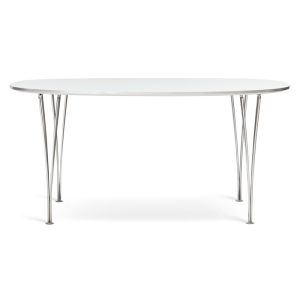
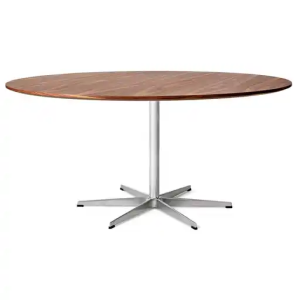
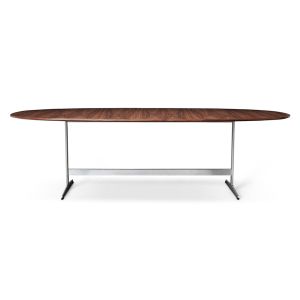
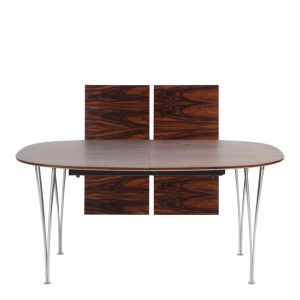
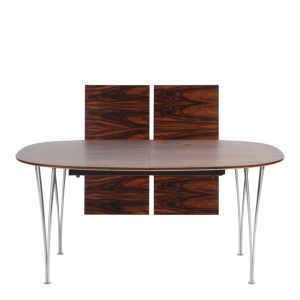
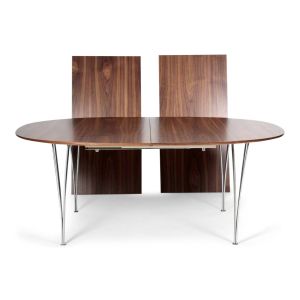
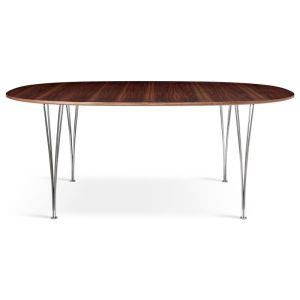
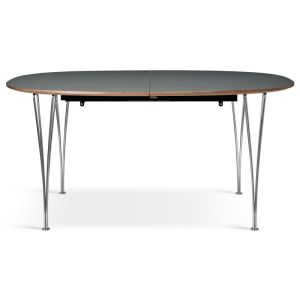
The popular form also proved exceptionally well suited to a tabletop. Its rounded corners create a pleasing flow around the table, while the outline remains balanced and harmonious at any size. In the 1960s, Fritz Hansen began producing Piet Hein’s bestselling Superellipse table, which continues to elevate interiors around the world. Hein’s Ellipse table is a defining work, and the Superellipse table is thoroughly timeless.
Today, the table is available in a wide range of colours and variations, all sharing its characteristic legs and, of course, the superellipse form. It is often paired with one of Arne Jacobsen’s chair designs, and Piet Hein is said to have joked about the unfairness that Arne Jacobsen sold six chairs every time he sold one table.
Piet Hein’s many masterpieces
His remarkable creative energy was not confined to short poems and an almost obsessive fascination with a single mathematical form. Today, a wealth of beautiful products can trace their origins to Piet Hein’s inventive mind.
Piet Hein appears to have been particularly fascinated by lighting, designing many well-known and lesser-known lamps. The understated Sinus lamp from 1967 is among the best known, while the Flora Folio from 1969 is one of the more spectacular. Naturally, the Super-Egg is also available as a lamp.
In 1944, Piet Hein was in Argentina, seeking refuge from the Nazis because of his anti-fascist work. Missing the familiar constellation of the Plough, he created a seven-branched candleholder whose flames trace its shape. That idea later inspired a range of candleholders bearing Piet Hein’s name and distinctive line.