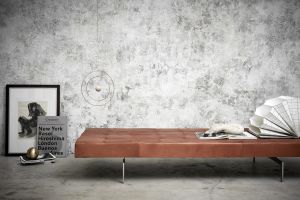
- New arrival
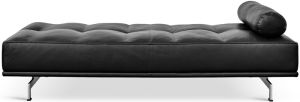
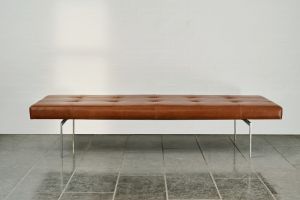
Functional Daybeds
This piece of furniture, designed for relaxation, conversation and afternoon naps, evolved through the Renaissance, Baroque and Rococo periods. Interest continued into the Victorian era, when fascination with the past renewed enthusiasm for the daybed’s form. It was also known as a fainting couch, inspired by tales of Victorian women fainting in the tightly laced corsets dictated by fashion.
These pieces were still a long way from the daybeds popular today. It was only with modernism that the contemporary daybed found its expression – and truly became part of the Danish furniture tradition.

Famous daybeds
Eileen Gray was one of the women who made her mark on early modernism. Her designs were distinctive yet part of a wider movement, and included several daybeds. The best known is perhaps The Day Bed from 1925, which still feels thoroughly modern today.
Le Corbusier introduced his iconic LC4 in 1928, a design at once simple and complex in expression. Created for exceptional comfort, it is now loved for its timeless form. With Le Corbusier’s daybed, this type of furniture became impossible for modernism’s leading designers to overlook.
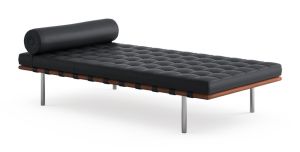
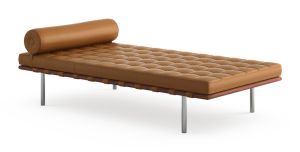
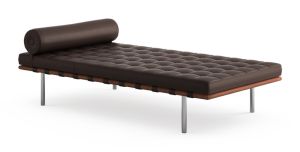
Ludwig Mies van der Rohe was another pioneer of modernism, and his role as head of the Bauhaus in the early 1930’s underlines his importance to the movement. He designed the German pavilion for the Barcelona International Exposition in 1929, an achievement that captivated the world. He created several pieces for the pavilion, including the celebrated Barcelona Day Bed.
There is no doubt that these leading international designers influenced Danish interpretations of the traditional divan.
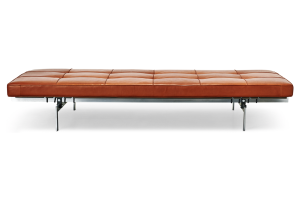
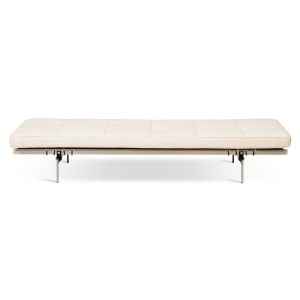
Poul Kjærholm’s iconic PK80 from 1959 clearly draws on these international masterpieces, yet its expression is disciplined and timeless. Chrome, leather and clean lines have made the PK80’s design a classic suited to almost any home.
Poul Volther, perhaps best known for his Corona Chair, designed a daybed in the early 1950’s that entered production towards the end of the decade. It is unmistakably Danish modernism, with timber frames and wool upholstery softening its strong lines. This beautiful piece is still produced and actively traded today.
Børge Mogensen’s interpretation of the form, the BMJ 4312, bears his unmistakable signature and is one of his defining works. The original featured the characteristic checks that became one of his hallmarks for a period, although it is now more often seen in subtler upholstery.
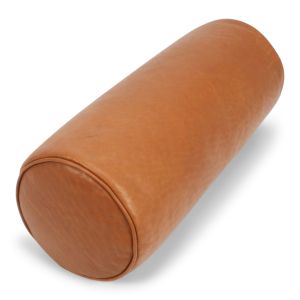
Re•Lax Daybed in leather
The upholstery is aniline leather, a material that proudly reveals its natural origins. Subtle traces of the animal’s life mean that no two hides are alike. Fine scars and variations in colour give every piece its own distinctive character and visual interest.
Aniline leather receives only minimal surface treatment, allowing owners to enjoy the beautiful patina it develops. This is a leather that ages gracefully rather than simply wearing out.
Always protect leather furniture from direct sunlight. Excessive heat and light affect both the material and its colour, so daybeds should also be kept away from radiators and wood-burning stoves.
Avoid soap and cleaning products, which can dry out the leather, and blot spills as quickly as possible. A well-wrung cloth, gentle vacuuming and an occasional wipe with a microfibre cloth are all suitable.
You may also consider treating the furniture with leather wax a few times a year to keep the hide soft and supple while extending the life of the upholstery.