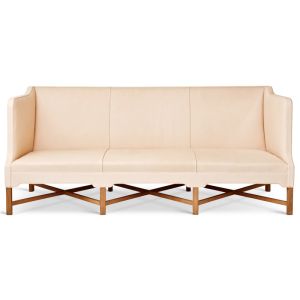
Architect Kaare Klint
Although Kaare Klint (1888-1954) may not have achieved the same international breakthrough and recognition as, for example, Arne Jacobsen and Hans J. Wegner, he may be the most influential of all Danish designers. It was Klint who shaped the golden generation of designers whose furniture remains highly sought after today.
It may have seemed destined from Kaare Klint’s birth that he would leave his mark on Danish aesthetics. He was the son of architect P.V. Jensen Klint, responsible for the striking Grundtvig’s Church in Bispebjerg and ’Bien’ at Trianglen. His siblings, Helle and Tage Klint, also distinguished themselves as designers and artists, while the name of Kaare Klint’s niece, Le Klint, has become associated with tens of thousands of lampshades in Denmark and abroad.
As a young man, Kaare Klint trained as an architect under his father and Carl Petersen. Petersen designed Faaborg Museum – for which Klint created his celebrated Faaborg Chair. Although Klint completed several notable architectural projects, furniture was where he made his greatest mark. He joined the Royal Danish Academy’s School of Furniture Design, and it was there that he played his most important role.
Klint’s approach to design would prove decisive for the remarkable course Danish design followed over the ensuing decades. He had little enthusiasm for dominant movements such as Bauhaus and Art Nouveau, instead working steadily towards what would become the foundations of Danish modernism.
He was deeply committed to function, quality and clean lines, principles that became almost dogmatic in his approach to furniture design. He studied the human body closely and based the proportions of his furniture on those studies. Materials and craftsmanship had to be of the highest quality, and each piece was intended to unite a room rather than dominate it.
These ideas were evident in Klint’s own limited body of work, but the young talents he taught also listened closely. They included Hans J. Wegner, Børge Mogensen, Poul Kjærholm and Arne Jacobsen, who embraced his ideas. Børge Mogensen in particular became a tireless advocate for the principles and ideals that propelled Danish design for three decades.

Kaare Klint’s chairs
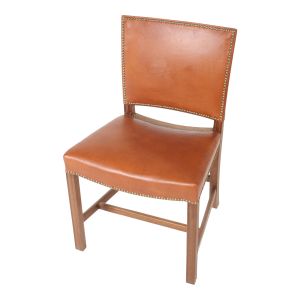
The Faaborg Chair, Safari Chair, Church Chair and Red Chair are probably the works for which Kaare Klint is best known and loved today. The Faaborg Chair from 1914, designed for Faaborg Museum, is often described as the first Danish design classic. The Red Chair from the late 1920’s earned considerable recognition at home and abroad, while the Church Chair from the mid-1930’s combines complex construction with a simple appearance. It is easy to see how the celebrated chair designed for Grundtvig’s Church paved the way for later classics.
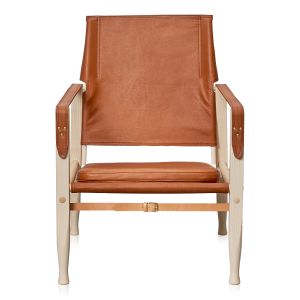
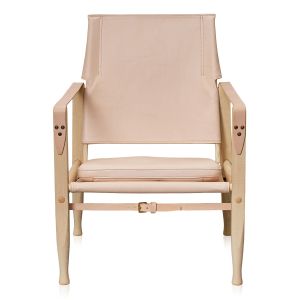
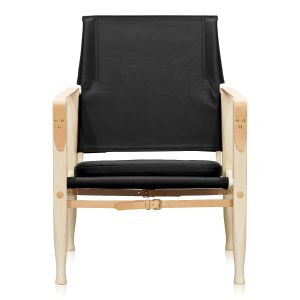
Kaare Klint’s Safari Chair from 1933 is arguably his greatest work and a landmark of Danish design. It was inspired by the canvas campaign chairs once carried across the savannah. Klint’s version elevated the form with materials such as teak, mahogany, rosewood and even oak, alongside a choice of leather or canvas for the backrest and seat. The Safari Chair may be Denmark’s first flat-pack piece of furniture and can be assembled without tools.