- New arrival
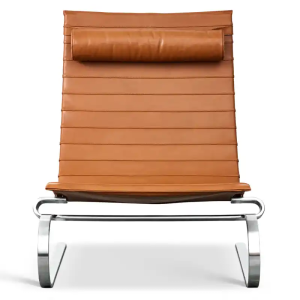
- New arrival
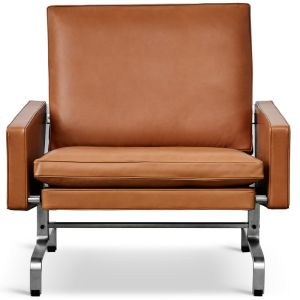
- New arrival
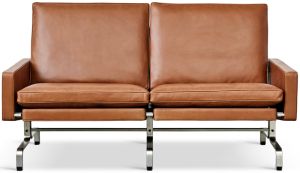
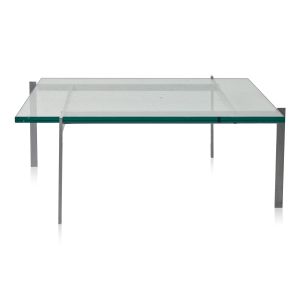
Designer Poul Kjærholm
Poul Kjærholm (1929-1980) was one of Denmark’s foremost designers and the creator of numerous enduring classics. Although part of the Danish modernist movement, he followed a distinctly individual path. His designs were exceptionally minimalist, which may explain their enduring appeal today. A chair by Poul Kjærholm can complement almost any interior.
He was born in Østervrå in northern Vendsyssel. After qualifying as a cabinetmaker in 1949, he moved to Copenhagen to study furniture design at the School of Arts and Crafts. While studying, he worked part-time for Hans J. Wegner. His career quickly gathered momentum, and he began working in earnest immediately after graduating in 1952.
He spent a year at Fritz Hansen and also taught at the school from which he had graduated. The defining moment for Poul Kjærholm came when he entered into partnership with his friend Ejvind Kold Christensen. Kold Christensen was able to produce the technically demanding furniture Kjærholm conceived, and their partnership lasted until the designer’s untimely death in 1980.
One might expect a trained cabinetmaker to share his peers’ affection for wood, yet steel became his signature material. He softened steel structures with leather, cane, flag halyard, glass and marble. Poul Kjærholm himself described steel’s ability to reflect light as central to his visual language, and the material recurs throughout his career.
Where many of his contemporaries were shaped by Kaare Klint and Danish modernism, Poul Kjærholm looked more resolutely abroad. His work clearly reveals the influence of Le Corbusier, Mies van der Rohe and other Bauhaus figures, while van der Rohe’s celebrated Barcelona furniture resonates through several of Kjærholm’s finest works.
While many of his colleagues championed furniture that ordinary people could afford, Poul Kjærholm pursued exclusivity from the outset. This was not disdain for the wider public – he was simply uncompromising in his choice of materials and design, and Ejvind Kold Christensen’s production costs placed the resulting pieces beyond many budgets.

Poul Kjærholm’s many designs
The furniture designer created a wealth of masterpieces, and Poul Kjærholm is known for far more than chairs alone. Many of his pieces are now collectors’ items, with examples from the E. Kold Christensen era commanding especially high prices.
PK25 is the chair that began it all in 1951. Created as his graduation project at the School of Arts and Crafts, it consists of a single piece of steel and one length of cord. Nothing more. A steel sheet – cut and folded without joints – and a continuous flag halyard forming the seat and back. It was the chair that brought the young furniture designer to international attention.
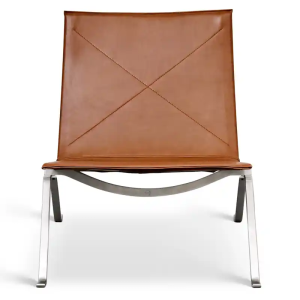
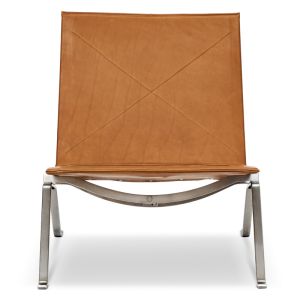
PK22 is without question Kjærholm’s best-known chair. Introduced in 1956, it refined his graduation piece from 1951. The influence of Mies van der Rohe’s Barcelona Chair, which captivated the world with its restrained beauty, is equally unmistakable. The PK22 is simpler still, and won the Grand Prix at the Milan Triennale the following year – the same year Arne Jacobsen’s chair of that name also won. The accolade established Poul Kjærholm as a name impossible to overlook, both in Denmark and internationally.
PK80 from 1957 also paid tribute to Mies van der Rohe’s iconic daybed from the Barcelona series. The PK80 is extraordinarily beautiful, exceptionally simple and remarkably valuable. Fine examples by the original manufacturer have been known to sell for 200.000 kroner today.
PK33 appears at once curiously out of place and entirely at home among Kjærholm’s furniture. This three-legged stool from 1959 is one of the few circular pieces by the trained cabinetmaker. Its expression is remarkably simple, yet its construction is exceptionally complex.
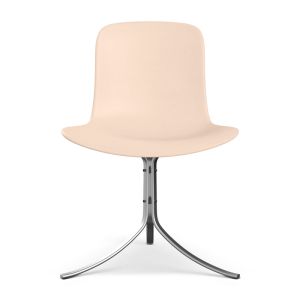
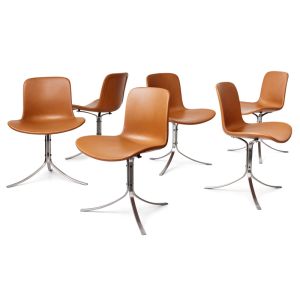
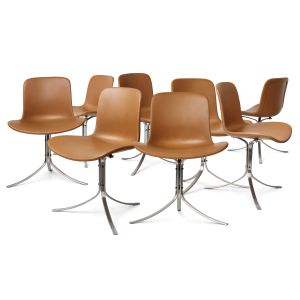
PK9 from 1961 is also known as the Tulip Chair, and its forms are rounder and more generous than much of Kjærholm’s earlier work. A near-mythical love story later became attached to the chair: his wife Hanne’s curves are said to have inspired its form.
PK31 is an almost archetypal Kjærholm study in steel, leather and razor-sharp edges. The sofas and chairs from 1964 are highly valuable today, and these minimalist pieces possess an undeniably timeless beauty.
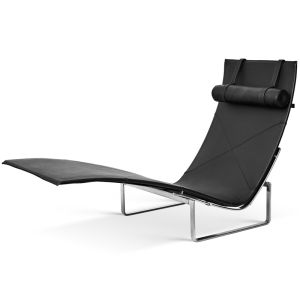
PK24 from 1965 likewise looks back to an earlier design, recalling Le Corbusier’s LC4 in an even more minimalist form. The PK24 appears almost to float and, even today, feels ahead of its time.
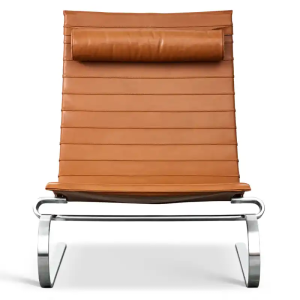
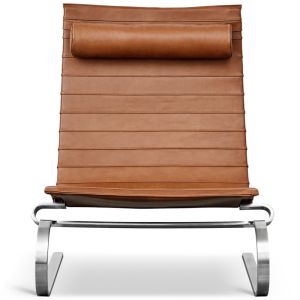
PK20 from 1967 is Kjærholm’s minimalist interpretation of a rocking chair. It too offers an elegant salute to the old masters, and this lounge chair is as comfortable as it is beautiful.