- New arrival
- New arrival
- New arrival
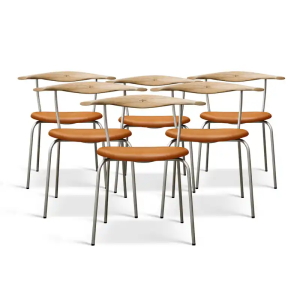
Designer chairs
With designers such as Hans J. Wegner, Arne Jacobsen and Børge Mogensen, to name only a few, it is easy to understand why the Danish furniture scene attracted worldwide attention in the mid-20th century.
The Danish modernists created one masterpiece after another. Their minimalist lines, uncompromising materials and fine craftsmanship ensure these chairs remain high on design enthusiasts’ wish lists.
Danish designer chairs have captivated the world
The sheer number of enduring chairs created by Danish designers during the 20th century is almost unimaginable. Kaare Klint, Arne Jacobsen, Hans J. Wegner, Børge Mogensen, Verner Panton, Poul Kjærholm, Poul Volther and Finn Juhl, to name only a few, all became standard-bearers for Danish modernism.
Several Danish designer chairs made a profound international impression, with works by Jacobsen and Wegner attracting particular attention. Arne Jacobsen’s Egg Chair is among the most iconic pieces in furniture history, while Swan Chair and the Series Seven are recognised by connoisseurs around the world.
Wegner’s Wishbone Chair is beloved and sought after in Denmark and abroad, but it is far from his only design to have travelled beyond the country’s borders. Even this is merely the beginning when it comes to classic Danish designer chairs.
The greatest Danish designer chairs
Kaare Klint
Faaborg Chair, KK96620, from 1914 by Kaare Klint may be Denmark’s first designer chair.
Safari Chair, KK47000, designed by Kaare Klint in 1933, is arguably the first modernist Danish lounge chair and the country’s first flat-pack furniture design. Simple, refined and beautiful, it is available in several timbers with either leather or canvas for the seat and back.
Børge Mogensen
People’s Chair, J39, from 1947 by Børge Mogensen has been loved for generations and is the bestselling wooden chair in Danish history.
Wing Chair, 2204, by Børge Mogensen was introduced in 1963, bridging minimalism and generous comfort. Part of Mogensen’s 2200 series, now found in many influential offices, this restrained chair with unmistakable curves is one of his greatest works.
Hunting Chair, 2229, from 1950 combines an exposed timber frame with natural saddle leather and brass buckles. The effect is striking: Børge Mogensen’s Danish-designed chair appears both rugged and elegant, open yet resolved. It proved a defining work for Mogensen and ranks among the finest Danish designer chairs.
Arne Jacobsen
Ant Chair, 3101, from 1952, was designed by Arne Jacobsen for Novo Nordisk and was his first shell chair. The Ant Chair is a milestone in Danish design, revealing the forms and functions made possible by new materials. Originally created with three legs, it is now also available in a four-legged version.
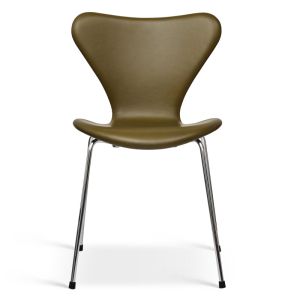
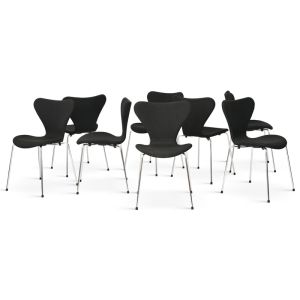
Series Seven, 3107, from 1955 is perhaps the Arne Jacobsen chair found in the greatest number of homes and offices, both in Denmark and abroad. One of the Danish design tradition’s most iconic works, it is made from pressure-moulded veneer; its versatility, stackability and exceptional quality have given the Series Seven extraordinary longevity.
Egg Chair, 3316, by Arne Jacobsen is one of the most beloved and iconic pieces ever created. Jacobsen designed it for the SAS Hotel, completed in 1958, and the chair captivated the world. His use of new synthetic materials enabled previously impossible forms, possibilities fully realised in the Egg Chair, available in leather or fabric.
Swan Chair, 3320, is another of Arne Jacobsen’s masterpieces and, like the Egg Chair, was created for the SAS Hotel in 1958. Made to be admired, the Swan Chair inhabits the boundary between furniture and sculpture. Apart from its base, it contains not a single straight line and remains iconic and highly sought after in Denmark and abroad.
Hans J. Wegner
Round Chair, PP501, PP503 and JH503, from 1949 is perhaps Hans J. Wegner’s greatest achievement. It certainly received extraordinary exposure when Nixon and Kennedy sat in the chairs during the world’s first televised presidential debate. The chair has enjoyed a remarkable life of its own ever since.
Wishbone Chair, CH24, is Wegner’s bestselling chair. Designed in 1949, it combines elements of two earlier successes: the Round Chair and China Chair. Beautiful, durable and exceptionally comfortable, it became a resounding success in Denmark and abroad.
Papa Bear Chair, PP19, from 1951 is an entirely uncompromising design that demanded much from both its makers and buyers’ budgets. In return, the Papa Bear Chair offered exceptional quality and was built to provide comfort for generations. Its international name was inspired by the armrests’ resemblance to embracing bear paws.
Shell Chair, CH07, from 1963 is one of Wegner’s most celebrated chairs. With three legs and a pressure-moulded plywood shell, the restrained design radiates a form of organic minimalism. Its natural materials and ray-like contours contrast with a futuristic expression that seems almost otherworldly
Poul Kjærholm
PK22 from 1956 is one of Poul Kjærholm’s best-known works. Even today, this exceptionally simple chair feels almost futuristically minimal. It found worldwide success, and the PK22 is available in numerous versions using canvas, leather and cane. The influence of Mies van der Rohe’s Barcelona Chair is easy to recognise, yet the PK22 remains unmistakably its own design.
Poul Volther’s
Corona Chair, EJ 5, from 1964 is perhaps Poul Volther’s best-known work, and this striking designer chair still seems light years ahead of its time. Its form and rib-like elements make the Corona Chair appear almost weightless, with extraordinary beauty. Coveted in Denmark and abroad, it is surely destined for a lasting place in furniture history.