- New arrival
- New arrival
- New arrival
- New arrival
- New arrival
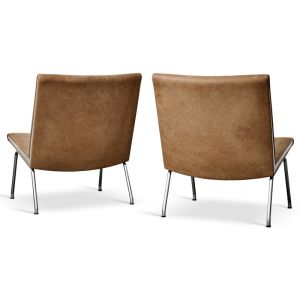
- New arrival
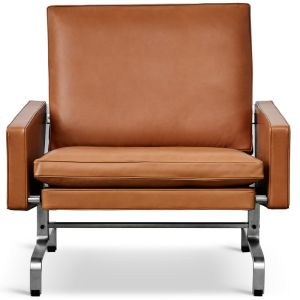
- New arrival
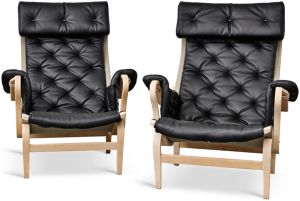
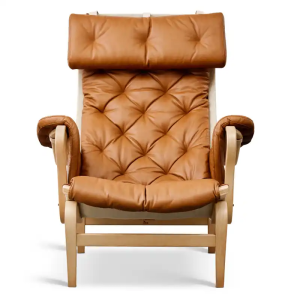
Finn Juhl created some of the most sought-after designer lounge chairs available, including the Chieftain Chair and 45 chair. Børge Mogensen, meanwhile, designed some of Denmark’s best-loved lounge chairs, such as the Wing Chair and Spanish Chair.
The designers behind the celebrated lounge chairs
The Danish design tradition abounds in masterpieces, ranging from artistic and almost opulent creations to austere, quintessentially Danish lounge chairs. The following furniture designers all created chairs that remain coveted around the world, leaving a formidable legacy for younger designers to follow:
- Arne Jacobsen
- Børge Mogensen
- Finn Juhl
- Poul Kjærholm
- Kaare Klint
- Hans J. Wegner
Their lounge chairs span a remarkable range of expressions, from black leather to light canvas.
Arne Jacobsen
Arne Jacobsen (1902-1971) created some of the most iconic lounge chairs of all time, and the Swan Chair and Egg Chair, created for the SAS Hotel in 1958, are known and loved around the world. Their rounded curves and almost feminine forms were designed to soften the hotel’s hard corners and straight lines – qualities that work just as beautifully in any other room.
At the opposite end of the spectrum is his lesser-known Ox Chair from 1966, with its exceptionally angular expression.
Børge Mogensen
Børge Mogensen (1914-1972) was extraordinarily productive throughout his career, and countless enduring pieces originated in his function-focused mind. Hunting Chair from 1950 was his first exploration of a more open furniture construction. Its exposed timber, leather and brass buckles found immediate favour, as did its successor, the Spanish Chair – with its characteristic broad armrests – which likewise combines saddle leather, timber and brass buckles.
Mogensen was equally a master of upholstered furniture, and his Wing Chair from 1963 is as comfortable as its expression is minimalist.
Finn Juhl
Finn Juhl (1912-1989) created a succession of coveted pieces, making an extraordinary contribution to the history of Danish designer lounge chairs. The 45 chair from 1945 is a study in elegant simplicity; its timber, leather and beautiful curves attracted attention in Denmark and abroad.
His best-known lounge chair may be the Chieftain Chair from 1949, which helped place Danish furniture firmly on the world map. It was followed by the France Chair from 1956, which combines the expressions of the two preceding chairs and played an important role in the success of Danish furniture exports to America.
Poul Kjærholm
Poul Kjærholm (1929-1980) followed a more individual path than many contemporaries, and his furniture in steel, leather, cord and cane often looked back to the pioneers of international modernism.
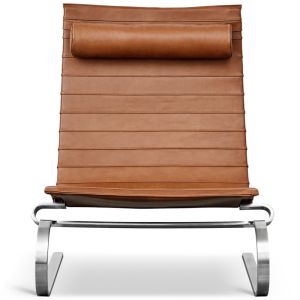
PK22 is undoubtedly his most widely known work, and this minimalist chair from 1956 still feels modern today. With the PK20 Kjærholm reinterpreted the rocking chair through a new, minimalist lens, with an exceptional result that deservedly appears on wish lists across Denmark.
Hans J. Wegner
Hans Jørgensen Wegner (1914-2007) was the master of the chair, and the sheer number of designer lounge chairs and designer chairshe created is almost beyond comprehension. CH25 from 1950 perfectly demonstrates what Wegner could achieve with the simplest means. Made from timber and cane, this graceful chair is as beautiful as it is comfortable – for some, the perfect lounge chair.
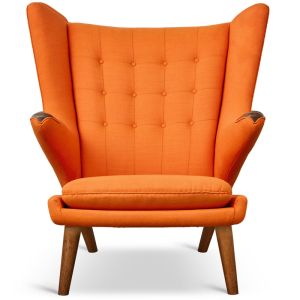
Papa Bear Chair from the following year has an entirely different expression and was built to endure for generations in both style and materials. It was followed by the Ox Chair in 1960, a chair that commands the room both physically and visually and is said to have been the master chairmaker’s own favourite.